The five levels of drywall finish
The Gypsum Association defines levels of drywall finish from 0 to 5. Each level describes how much finishing work is applied over the board:
| Level | Description | Typical application |
|---|---|---|
| Level 0 | No finishing at all | Temporary construction only |
| Level 1 | Tape embedded in compound | Hidden spaces above ceilings |
| Level 2 | One coat over tape | Garages, warehouses |
| Level 3 | Two coats | Under heavy texture |
| Level 4 | Three coats, sanded smooth | Standard residential, flat paint |
| Level 5 | Level 4 plus a full skim coat | Custom homes, any paint sheen |
What makes Level 5 different
The difference between Level 4 and Level 5 is a full skim coat over the entire wall and ceiling surface, not just over the joints. It creates a uniform surface with no difference in texture or porosity between the joint compound and the paper face of the board.
Why does that matter? Flat paint hides surface variation. Eggshell, satin, semi-gloss and gloss paint don't. When a wall is side-lit by a window, or grazed by a pot light at a low angle, every slight ridge, fastener and feathered joint casts a shadow. Level 5 removes those shadows.
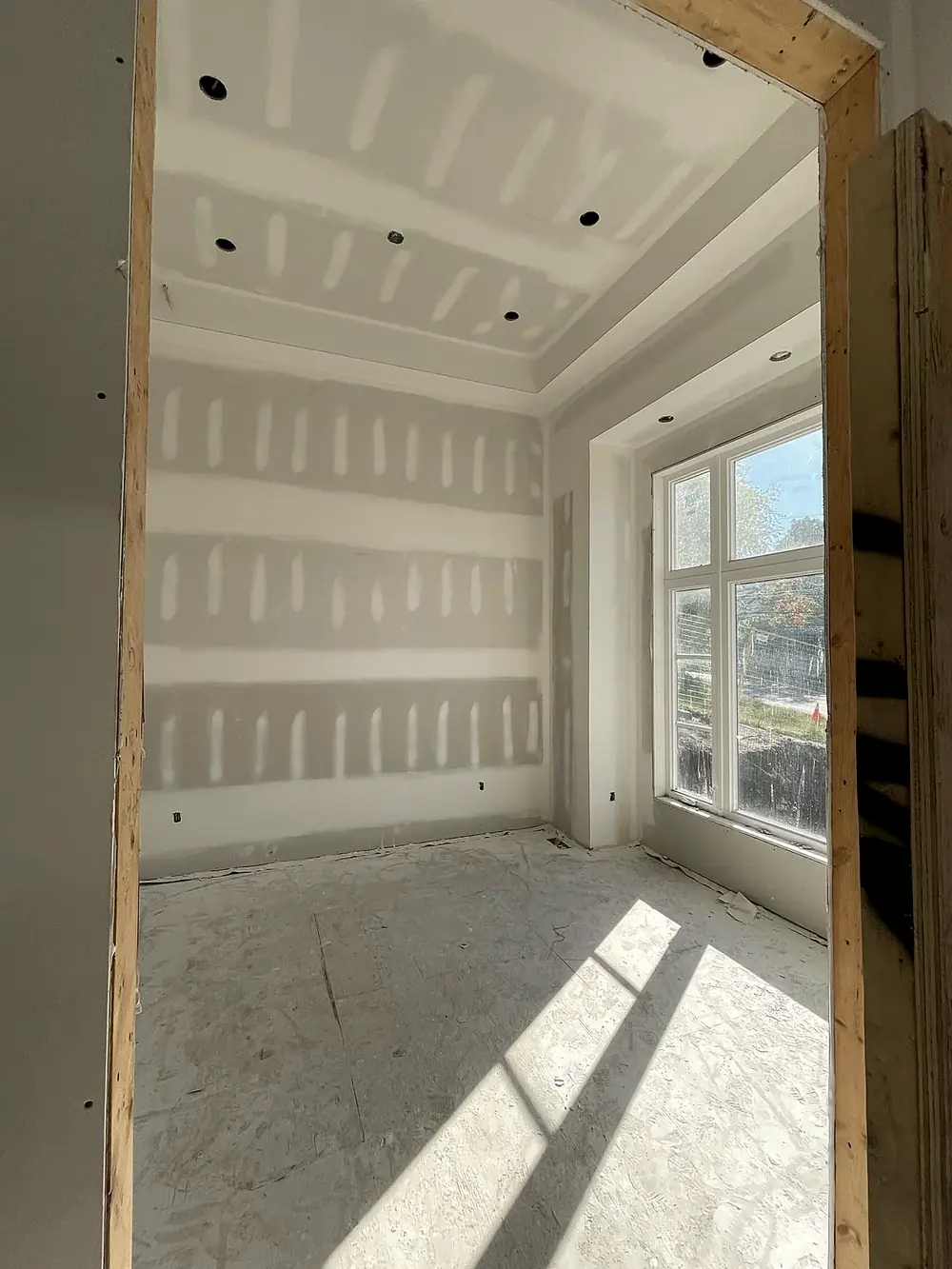
When Level 5 is the right call
- Painting with any sheen above flat: eggshell, satin, semi-gloss or gloss
- Walls side-lit by large windows or grazing pot lights
- High ceilings where light rakes across the surface
- Venetian plaster or other decorative finishes
- Any luxury custom home where quality is non-negotiable
For a basement rec room painted flat, or a closet, Level 4 is perfectly appropriate. The point is to match the finish to the light and the paint.
The complaint we hear most
Homeowners who used a cheaper crew call us after painting, asking why they can see every joint in certain light. The answer is almost always Level 4 on walls that needed Level 5. Fixing it after paint means more compound, more sanding and repainting: far more expensive than doing it right the first time.
How much extra does Level 5 cost?
Level 5 adds approximately $0.75 to $1.50 per square foot of surface to the drywall price. On a 4,000 sq ft custom home with about 10,000 sq ft of wall and ceiling surface, that's roughly $7,500–$15,000 extra. It's one of the best-value upgrades on a luxury build, because the walls look right in any light and any paint for the life of the home.
| Where your job lands | Per sq ft of surface | What drives it |
|---|---|---|
| Simple rooms | $2.50 – $3.50 | Standard 8–9′ ceilings, few corners |
| Typical home | $3.50 – $4.50 | A mix of standard and feature ceilings, bulkheads, more corners |
| Complex & luxury | $4.50 – $5.50 | Coffered and curved ceilings, tall walls, Level 5 finish |
| Basements | $2.50 – $5.50+ | Can run higher: bulkheads, soffits and corners mean more taping |
| Commercial & multi-unit | $2.50 – $4.00 | Long straight partitions, Level 4 finish |
Drywall and taping together, materials included: board, compound, tape, screws and corner bead, hung, taped in three coats with drying time, and sanded. Homes $2.50–$5.50; commercial $2.50–$4.00. Per square foot of wall and ceiling surface (not floor area). Framing, insulation, primer and paint quoted separately. Your on-site quote is exact.
Rule of thumb: the drywall (material) you need is roughly your floor area × 3.5 in square feet of board. Multiply that by our rate, or simply multiply your floor area by $8.75–$19.25 ($2.50–$5.50 × 3.5). Your free site visit measures it exactly and turns it into a written price. Get your exact number →
How long it adds
Allow an extra 2–4 working days for Level 5 compared with Level 4. The skim coat needs to dry, and then it gets a final sanding pass. See how long does drywall take?
How Level 5 is applied
The skim coat goes on after the joints are taped and coated to Level 4. There are two common methods: a thin coat of compound applied with a trowel or roller and wiped down tight, or a spray-applied surfacing material. Either way, the goal is a uniform, thin film over the entire face of the board. Then comes a final sanding pass, checked under a work light held flat to the wall so any remaining ridges throw a shadow. Good lighting during finishing is what separates a real Level 5 from a "Level 4 with extra mud".
Primer matters too
Even a perfect Level 5 needs the right primer. A quality drywall primer seals the surface evenly so the finish paint dries to a uniform sheen. Skipping primer, or using paint-and-primer in one coat on fresh drywall, can bring back the very flashing that Level 5 was meant to prevent. Tell your painter the walls are Level 5 so they treat them accordingly.
Level 5 is our custom home standard
At LR Contracting, Level 5 is our standard on Oakville custom home projects, because we know what the light in these homes does to walls that aren't properly finished. Learn more on our custom home drywall and taping & finishing pages.
Common questions
What is the difference between Level 4 and Level 5 drywall?
Level 4 is three coats over the joints, sanded smooth. Level 5 adds a full skim coat over the entire surface so the paint sees a uniform surface.
How much does Level 5 drywall cost?
About $0.75 to $1.50 per square foot of surface on top of the base drywall price in Halton.
Do I need Level 5 with flat paint?
Usually not, unless walls are strongly side-lit or have very high ceilings. With eggshell or higher sheen paint, Level 5 is recommended.